
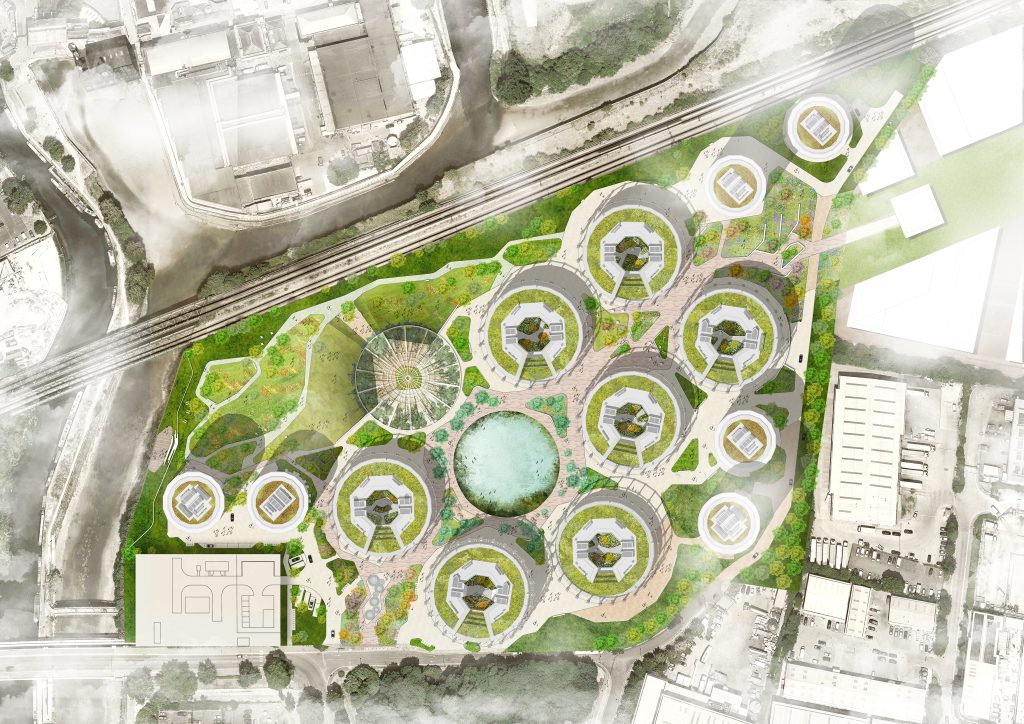
Bromley-by-Bow Gasworks is a key part of London’s industrial history, featuring the UK’s largest collection of Grade II-listed gasholders. St William – a Berkeley Group company – is regenerating the disused brownfield site into a residential riverside complex, in which 70% of the land will be open to public access for the first time in 150 years. This includes a 4.2-acre riverside park fronting the River Lea.
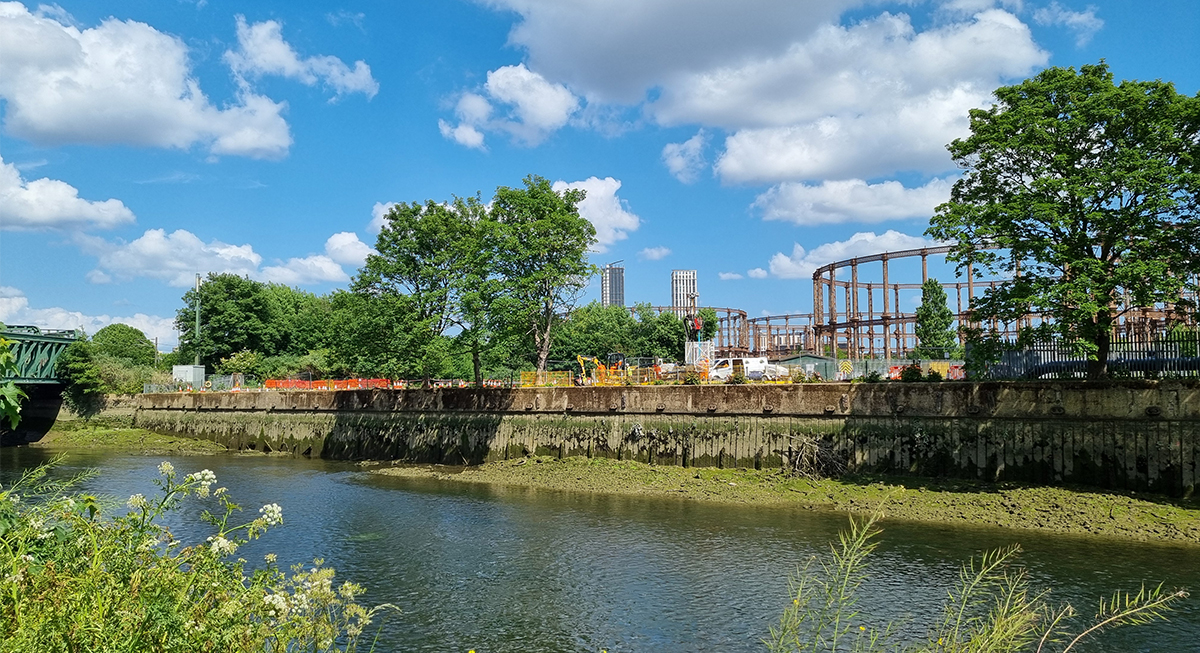
Approximately 170m in length, the site’s river wall provides embankment and flood defence protection from the tidal Bow creek river. Beckett Rankine was commissioned to conduct surveys and investigations of the river frontage to establish its condition.
The investigations were key to the overall development’s successful planning application, as they demonstrated that the wall could be reused and stand for another 100 years, avoiding a full replacement.
Beckett Rankine conducted an initial visual inspection in 2023. With next-to-no information on the wall’s original construction, we determined that the wall was likely constructed in two phases, with the precast concrete sheet piles installed in the 1930s or 40s and a reinforced concrete top added in the 1970s or 80s to raise the river wall height.
We found that the river wall is generally in good condition for its age and recommended that it could be reused, provided some remedial measures are taken to prevent further deterioration and maintain another 100-year lifespan.
After this survey, the initial planning application was granted with conditions from the Environment Agency, which required further detailed investigations.
Beckett Rankine worked closely with the Environment Agency to scope a more detailed survey.
The aims were to: fully verify the form and condition of the existing wall; further assess any identified defects; validate the ground conditions behind the wall; and verify the riverbed conditions to inform the scour assessment of the new outfall.
The site presented complex challenges to mitigate, including restricted access, poor ground conditions, legacy contamination, and the presence of a gas main behind the river wall.
The ground investigation survey was conducted by AtkinsRéalis with Beckett Rankine supervision, involving:
We interpreted the results of the ground investigation and demonstrated that the river wall could be reused for a further 100-years with minor remedial work needed. The reuse of the wall is paired with a planned-out monitoring and maintenance plan for the proposed development.
We also designed the riverside landscaping to incorporate a bund behind the wall, creating a flood defence that satisfies the Thames Estuary 2100 requirements, without the high cost of raising the river wall’s height.
The report findings led to the Environment Agency’s conditions being discharged, enabling the development to be granted planning permission.
The project demonstrated the value of early collaboration and investment in detailed ground investigations – by establishing that the river wall could be reused rather than rebuilt, the client saved significant time, money, and carbon emissions.
Reusing the river wall saves the client a projected £2.5-3 million and 3,000 t of carbon emissions compared to rebuilding it, excluding demolition and temporary works costs.
It also avoids adding 6-9 months to the construction programme and the costs and delays that further statutory consent applications and licenses would accumulate.
The Bromley-by-Bow ground investigation project is a finalist in two categories of the Ground Engineering Awards 2026:
The awards recognise ground engineering projects that stand out for their innovation, collaboration, quality, sustainability, health and safety, and value engineering.
