
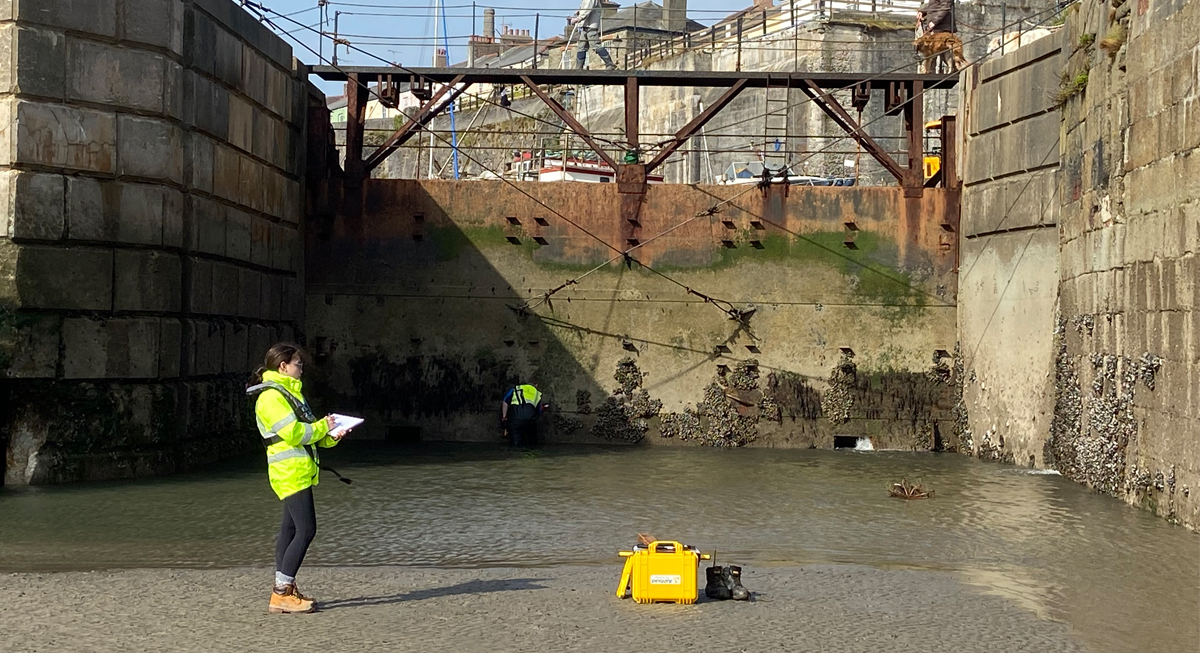
Charlestown Harbour is a small historic port in Cornwall, originally built in the late 1700s. The Grade II-listed harbour is the last open Georgian Port and a UNESCO World Heritage Site, featuring an inner and outer harbour separated by a flap lock gate.
Beckett Rankine designed and project-managed repairs and regeneration work for Charlestown Harbour, including the work package to replace the lock gate.
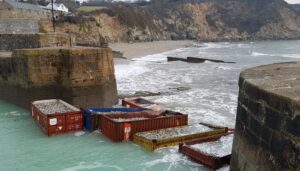
In 2021, winter storms inflicted significant damage to the outer harbour and water entered the historic stone wall, leading to a section collapsing into the sea.
Beckett Rankine was brought on board to design and oversee the repairs.
The site is difficult for construction equipment to access. We implemented a creative solution by importing large quantities of crushed rock from a nearby quarry to build a temporary causeway that gave a solid platform for construction.
We also faced the challenge of keeping the waves outside the harbour and away from the works, especially at higher tidal levels. Our solution was to fill empty shipping containers with some of the crushed rock, placing them in the Harbour entrance as a temporary breakwater. This simple and practical measure proved highly effective and kept the waves at bay, even when the tide came in.
Once work was complete, the containers were removed and recycled, and the quarry rock was reused on other projects.
The lock gate finally succumbed to winter storms in October 2024, with a breach that drained the water from the inner harbour.
Beckett Rankine helped to co-ordinate the emergency response, which included transporting historic ships to a nearby harbour and installing a temporary cofferdam to protect the harbour.
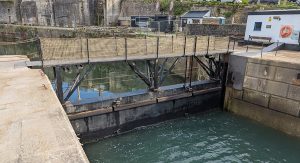
As the existing lock gate was determined to be unsafe, we devised a modular replacement gate that updates and reinforces the original design while meeting modern design and safety standards. Importantly, the new lock gate is also designed to improve the harbour’s climate resilience and remain aesthetically in character with its heritage.
The modular design enabled ease of transport and installation, as well as ensuring that future repairs or replacements can be localised in sections for faster, more sustainable and cost-efficient maintenance.
Many of the new features enable the gate to withstand larger waves, which is a growing concern as climate change increases the wave forces entering the harbour.
The original gate had no functioning sluice gates for 20 years, so these have been reintroduced in the new design to help with maintenance. At 60% open, the sluice gates are powerful enough to fill an Olympic swimming pool in 7 minutes, or the equivalent of 10 household baths each second.
Additionally, hard-wearing timbers were added to protect the gate when vessels pass over it while open, as well as modern safety features such as flashing lights, barriers and walkway safety netting.
In April 2025, the original lock gate was lifted and removed by ConstructEx – the first time since it was installed in 1971.
The gate weighed in the region of 50 tonnes, with around 20 tonnes being mud and fouling alone. It was lifted manually over a three-day period, with the support of strategically placed chain blocks that were digitally monitored for careful, even movements.
The old gate has been recycled, though Charlestown Harbour kept some parts to feature in heritage displays about the harbour’s engineering history, including the 55-year-old winch.
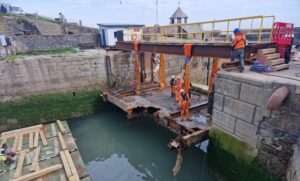
Throughout summer 2025, the gate, sheave and winch designs were finalised and preparatory works began.
The new gate installation involved a complicated process throughout the 2025/26 winter, as works could only be carried out during the narrow window of a Spring tide. A temporary barrier was put in place to protect the gate and inner harbour from waves, particularly important during winter storms.
The gate modules were transported to Charlestown via road and assembled on a pontoon in autumn 2025. The project team carried out precision engineering to fine-tune the bearings and alignment, then lifted the gate into position in December.
In January and February 2026, the winches and sheaves, walkway, and safety features were the final elements to be installed.
Next, the inner harbour will be re-filled so that Charlestown Harbour can open once again, celebrating the occasion with a public event in Spring 2026.
The project team faced a multitude of challenges, largely unique to the project, that required creative solutions and flexibility to overcome.
