
J Monasta, Beckett Rankine UK.
SUMMARY
This paper explores the challenges and opportunities of using docks as basins for the preservation and interpretation of static historic ships, reflecting their growing significance in the UK’s maritime heritage sector. In particular, it examines the role of historic docks and how the availability of aging and disused docks can serve as valuable assets for the preservation of historic ships. However, this approach also presents important complexities that are often overlooked during the planning and development phases of such projects. A selection of case studies are analysed to present a discussion of the key advantages and disadvantages of integrating historic ships within dry docks.
1. INTRODUCTION
Ships and docks are intrinsically entwined in a mutually beneficial relationship. In all areas of a ship’s lifecycle, from construction and maintenance to decommissioning and deconstruction, docks are essential. They are critical to keeping ships seaworthy, with regular docking an essential component of a ship’s maintenance schedule. Additionally, docking is fundamental when altering a vessel’s functions and facilities as their purpose evolves.
Equally, docks need ships. Docks are created and supported by vessel construction and maintenance; without the occupation of an active shipping industry, docks often lose their purpose and fall into disuse and disrepair.
Transitioning ships from working to historic vessels presents challenges and opportunities, namely an increase in maintenance and intervention burden, coupled with reduced income and limited funding. Additionally, these vessels frequently become stationary assets presented as museums or exhibits, which can greatly increase emotional and logistical connectivity with their surrounding environments and communities. Their new role as historic attractions leads to increased public accessibility requirements, while conversely decreasing the need to maintain propulsion and navigation systems, in turn removing the requirement to meet minimum compliance requirements (Millar, Thomas and Monasta, 2024).
Naturally, the evolution of a ship’s purpose directly impacts the suitability and functions of its dock. Docks remain as fundamental as ever – if not more so – in the on-going maintenance of an historic vessel. Transporting an historic vessel to a dry dock for maintenance is logistically complex, expensive and laden with potential risks. These challenges can be mitigated by situating the vessel permanently within a dry dock where available, providing a long-term home for historic vessels that facilitates maintenance and reduces conservation costs. Additionally, incorporating the dock itself as part of the maritime heritage attraction alongside the vessel can provide new opportunities for public accessibility and interpretation, thus allowing the vessels to interface more effectively with museums and communities.
The often-under-appreciated role of docks has, in some instances, led to significant deterioration following their abandonment. The docks themselves can be unique and valuable historical artifacts, with over 40 dry docks Grade II listed by Historic England (Historic England, n.d.). In such instances where the dock is also of historic interest, its integration with the historic vessel’s conservation management can inject much-needed public interest and funding into the dock’s preservation under the umbrella of wider maritime heritage conservation initiatives.
Even when not listed or of historical significance, the closure of a significant number of shipyards in the UK following the collapse of the sector in the 1980s (Stott, 2023) has left numerous docks and facilities scattered around the British coastline requiring post-industrial regeneration.
While some attention has been given to the importance and impacts on historic vessels when they are permanently dry-docked, less has been given to the impact on the docks themselves. Through reference to various case studies, this paper investigates the interdependencies between historic ships and docks. In particular, the use of docks and their suitability for housing these heritage assets will be discussed, with reference to cases where purpose-built docks were preferred.
2. CONSERVATION OF HISTORIC SHIPS
During their working lives, ships undergo functional conservation, where they are repaired and maintained to ensure their ongoing operability. This work is financially viable due to the vessel’s earning potential and intrinsic value. Maintenance is carried out by the crew while at sea, often including dedicated shipwrights or engineers, and by specialist teams during scheduled dry-docking periods.
As working ships transition to historic vessels, their conservation must be managed within different constraints. Preserving historic ships is a complex balancing act involving multiple, often competing, factors.
Many historic ships are maintained by small groups without formal training or certified skills (NHS-UK, 2010). These ships rely on visitors, donations, and external funding for financial sustainability (Keown et al., 2024; BOP Consulting & Raybel Charters, 2024). Constant consideration is required for financial sustainability, structural integrity, preservation of historic fabric, interpretation, and accessibility. Owners, curators, and volunteers face significant challenges in navigating these complexities, which are further complicated by the strong emotional connections people form with historic ships.
In practice, funding remains the primary constraint in the conservation of historic ships. Operational costs are typically covered through visitor fees, public donations, and events. However, these sources are often insufficient to meet full maintenance requirements, leading to gradual degradation. This necessitates major restoration campaigns at regular intervals, which are typically funded through external bodies such as the National Lottery Heritage Fund and the National Heritage Memorial Fund in the UK. As demand for these funds increases, many vessels find themselves caught in cycles of limited, low-quality maintenance, punctuated by sporadic, small-scale restoration efforts that are constrained by financial limitations.
In recent years, these challenges have intensified. Securing financial support, such as UK Heritage Lottery Funding, has become increasingly competitive (Keown et al., 2024). Modern regulations have driven costs up and added complexity, making maintenance and restoration more difficult to deliver. The long-term decline of the United Kingdom’s shipbuilding industry (Stott, 2023) has led to a loss of traditional skills necessary for vessel upkeep, as well as the neglect or demolition of key facilities. Replicating historical methods and materials is often prohibitively expensive, putting many historic vessels at risk. These difficulties have resulted in the deterioration or loss of ships such as the Esther, HMS Bronington, and PS Lincoln Castle.
Due to financial, geographical, and logistical constraints, regular access to dry docks is not always feasible. Furthermore, as vessels deteriorate and the costs of dry-docking rise, the financial burden and risk associated with traveling to commercial dry docks grow significantly. As a result, permanently situating vessels in a dry dock basin becomes an attractive option. This allows direct access to facilities that can de-water the vessel, eliminate the need for risky tows, and remove expensive docking rental costs. While access to skilled labour remains a concern, the availability of dedicated facilities can help attract professionals, improving maintenance quality and mitigating some cost constraints.
Conversely, historic docks also benefit from the presence of historic vessels. For example, Portsmouth’s No. 2 Dock is now the oldest operational dock in the world. Similarly, while SS Great Britain’s dock was still operational when the ship returned, its continued presence has ensured ongoing upkeep. In contrast, the adjacent Albion Dockyard was derelict between 2016 and 2019 and is now proposed for redevelopment by SS Great Britain’s managing trust to house a replica of the SS Great Western (NHS-UK, n.d.).
3. CASE STUDIES
To improve maintenance, accessibility and interpretation, a number of historic ships around the UK are now permanently located within dry docks. While each situation is unique, these case studies enable greater understanding of the benefits and risks of this approach. A number are presented briefly in this section, with the key lessons learned for other vessels highlighted.
HMS Victory
HMS Victory presents one of the earliest examples of a ship conserved beyond its working lifespan due to its historical significance. After the end of its naval career, Victory gradually fell into a condition of disrepair and, in 1922, was transferred into Portsmouth Harbour’s No. 2 dock (Aberg, 2005). This move was initially motivated by an urgent requirement for restoration. Upon its arrival, Victory was found to be in such poor condition that refloating was deemed impossible – it was estimated that between a third and half of its fabric required replacement (Aberg, 2005). As such the ship has remained within the dock to allow the continuous restoration and maintenance that it requires. This is one of the core benefits of placing historic vessels within docks. Having constant and comprehensive access to the hull facilitates monitoring and intervention. In turn, this reduces loss of historic fabric and risk of deterioration, lowers the costs of carrying out works and permits the vessel to remain at least partially open to the public during the works.
The permanent drydocking of Victory in the historic dock did not account for the long-term effects of keeping a timber ship out of the water. The rudimentary cradle initially installed within the dock did not suitably support the timber hull, resulting in deformation and degradation over time due to creep in the timber planking. Combined with the movements of the historic stone and masonry dock due to tidal and seasonal variations, this has caused significant costs and loss of historic fabric. A new cradling system was recently introduced (BBC, 2020) to provide superior support to Victory, at significant capital and operational expenditure.
HMS Unicorn
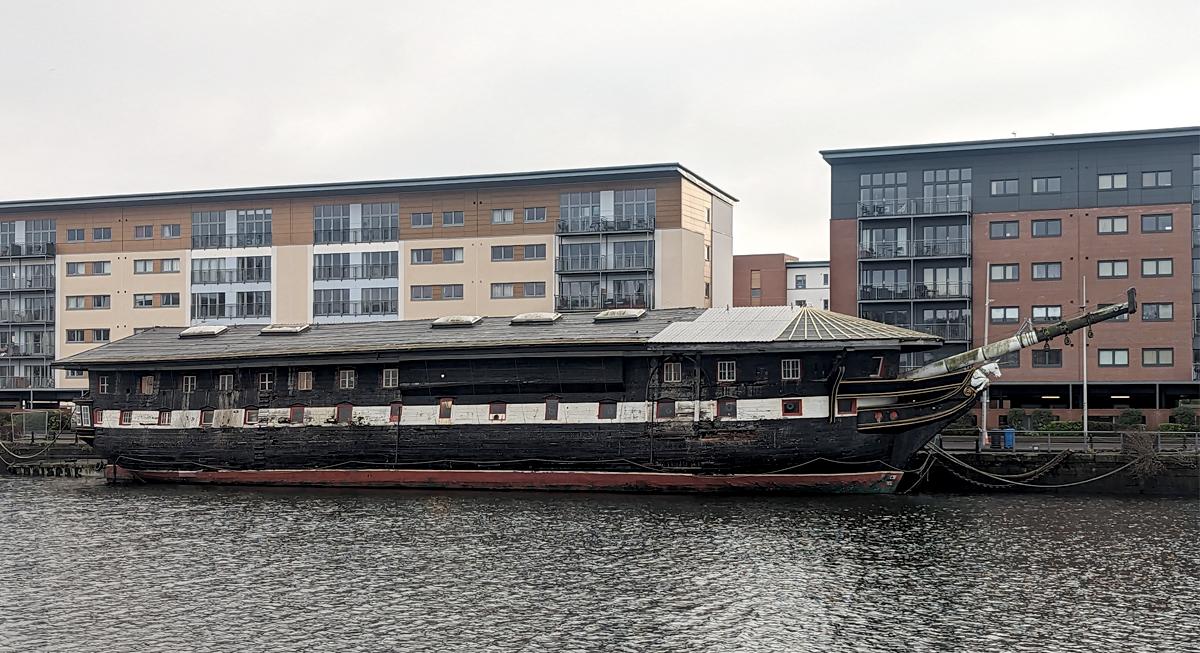
At the time of writing, HMS Unicorn in Dundee is in a comparable position to HMS Victory in 1922. A 200-year-old timber frigate, Unicorn has not been dry docked since 1971. It is now in poor condition with pronounced hogging. Due to geographical constraints, HMS Unicorn is currently trapped within a dock system, and unable to access a working dry dock, which has led to the current extent of degradation and critical threat to the ship’s ongoing survival. Adjacent to Unicorn is the East Graving Dock, a masonry Victorian Dock, that was abandoned in 1990s. This basin is the only location available for the restoration works Unicorn sorely requires (UPS, n.d.). Once the works are completed, it is intended that the dock shall serve as a permanent home to the vessel, with the dock itself repurposed to house a new museum space and public realm. In this way, docks can provide certainty for historic vessels and a stable environment in which long-term plans can be made.
Docks can provide the facilities necessary for ongoing conservation, reducing reliance upon external parties, and helping to avoid the situation in which Unicorn now finds itself. However, the degraded and derelict condition of the dock are an additional cost and risk that the project must be suitably accounted for as part of the wider project.
It is worth noting that prior to the involvement of HMS Unicorn, there were no plans for the restoration of the East Graving Dock, with its future and condition uncertain. Consultation during the optioneering phase for HMS Unicorn revealed that Historic Environment Scotland were supportive of any initiative that would allow the listed dock to be regenerated .The proposed use as a permanent home for HMS Unicorn was approved in part due to the additional historical context provided by the dock, demonstrating the willingness of government bodies to use historic ship projects as a vehicle to regenerate disused docks.
Arctic Corsair
Arctic Corsair is a 1960s deep-sea trawler and is the last survivor of the fishing fleets that operated in the North Sea from the Humber. It was involved in the Cod Wars and is an icon of the city. The Hull Maritime Project involves a city-wide regeneration scheme that started in 2018, and includes the restoration of the Arctic Corsair, and the renovation of the former North End Shipyard to serve as the permanent home of Arctic Corsair (Hull Maritime, n.d.).
The North End Shipyard has been in a state of abandonment and disrepair since the 1990s, and required significant amounts of work, including silt removal, wall repair, drainage upgrade and gate replacement. Furthermore, the dock was not originally built as a basin, but was the entrance to the wider Queens Dock, which was constructed at the end of the 1700s. The entrance was modified and transformed into a drydock following the closure of the Queens Dock and its infilling in the 1930s. Unfortunately, there are no records of the works and modifications made to build the North End Shipyard dock, except for some photographic evidence. This introduces challenges for its use as the home of the Arctic Corsair. Even the drydocking operation that is planned for 2025-2026 will require careful planning, due to depth constraints on the approach; a high dock block design to improve accessibility; and only a small tidal window to allow the 62m trawler to safely enter and dock in her new permanent home.
SS Great Britain
In contrast, when SS Great Britain was returned to the Great Western Dockyard in Bristol in 1970, the dock was still part of an operational shipyard. After restoration within its dock, the ship was opened to the public as a museum. However, in 1998 it was discovered that severe corrosion of SS Great Britain was ongoing within the dock, threatening the remaining historic fabric and structural integrity of the ship. To address this and further support the ship’s structure, a glass structure was constructed around the ship’s waterline. This creates a de-humidified environment within the dock that can be effectively monitored and controlled. It has reduced the ongoing loss of historic fabric from the hull and created a unique space within the dock for visitors to examine the ship’s underside (Watkinson & Tanner, 2008). In addition, it has enabled the installation of lifts for improved public access, increasing the site’s functionality as a museum.
The dock itself though, that was supposed to be a temporary structure when built for the construction of SS Great Britain, also has structural issues, particularly relating to movement and water ingress. This last issue is of particular concern, as the dock is effectively fighting the humidity control systems used to maintain the ship’s hull.
HMS Trincomalee and Wingfield Castle
The preceding case studies are ships that are, or will be, sited within drained docks. An alternative approach is to leave vessels afloat within their dock. The dock can then be emptied when the vessel requires maintenance.
This is the case for HMS Trincomalee, which is afloat within a dry dock in the National Museum of the Royal Navy in Hartlepool. This provides interpretational benefits as the ship is displayed afloat within the surrounding museum, which is designed in the style of a Georgian quayside. In addition, keeping the ship afloat retains flexibility in long-term decision making. If deemed preferable in the future, the ship can be permanently dry-docked. However, this would ultimately be an irreversible process due to the loss of strength and deformation as timbers dry out. Keeping the ship afloat retains a broader range of long-term options. Furthermore, keeping the timber ship afloat in salt water is one of the preferred methods to preserve and support the timber structures.
Similarly to the North End Shipyard in Hull, the Trincomalee Dock is a repurposed dock, based on an original graving dock, that was covered over, and then subsequently dug out and repurposed. Again, similarly to North End Shipyard, there is no information on the makeup of this dock, nor of the subsequent modifications. Furthermore, due to the need for the dock to maintain a positive head in case of a dewatering of the main Hartlepool Marina, the original mitre gates were replaced with a novel solution, which has proven to be ineffective and has been concreted in while waiting for a new design.
The gate and the unorthodox design mean that moving HMS Trincomalee in and out of the dock is a significant challenge. The last operation was performed on a Spring tide and the vessel became stuck on the cill, requiring ballast movements and a clump weight positioned on the bow sprit to “rock” it over the cill.
Of note, the museum ship PS Wingfield Castle is moored next to HMS Trincomalee in the Hartlepool marina . Wingfield Castle is owned by Hartlepool Council and, due to ongoing financial constraints and diminishing budgets, is in a very poor state. As a result, Wingfield Castle has degraded significantly over time and is now closed to the public.
Due to modifications to the Hartlepool Marina gates, neither Wingfield Castle nor Trincomalee can leave the marina. As such, Wingfield Castle can only be docked within HMS Trincomalee’s dock for any remedial work. This means the two vessels’ future survival is dependent on each other and on the use of the Trincomalee Dock, which is itself not currently in a suitable condition requiring substantial modification for Trincomalee to safely exit and Wingfield Castle to enter.
Purpose-built Docks
While the examples discussed thus far relate to historic docks that have been repurposed to house historic ships, there are also examples of docks that have been built for this purpose.
For example, the timber polar exploration vessel RRS Discovery is located in Dundee, within a dock built for the ship’s return in 1992. The dock was built using a wider dock as the foundation for the new purpose built structure. At the time of writing, the dock is drained to allow major remedial works to be carried out to the ship. Upon completion thereof, it is planned that Discovery will be refloated within this facility. In this situation, floating is preferred as immersion in salt water can help to preserve the timbers. This can reduce the frequency of required works, improving financial and environmental sustainability.
Innovative interpretational choices have been adopted on the Cutty Sark, in Greenwich, London. This former tea clipper was installed in a custom-built dry dock in 1954. After a costly and complex restoration process beginning in 2006, the ship has been raised 3m above its dock on a steel frame and is partially enclosed by a glass canopy to the waterline. To the external viewer, it is intended to seem afloat, while from beneath, the elegant and sleek lines of the hull are emphasised. The underlying chamber is used as museum space and for events, providing an extra source of income (Royal Museums Greenwich, 2013). Through changing the manner in which visitors interact with historic vessels, docks offer new opportunities for public accessibility and interpretation.
Moving beyond the UK, the iron-hulled ship SS Pommern sits afloat within a bespoke dock in the Åland Islands, adjacent to Mariehamn’s maritime museum (Hagmark & Eriksson, 2019). The dock was completed in 2019, and its primary purpose is to enable the ship to be dry-docked in-situ. This allows inspection and maintenance works to be carried out without towing the ship elsewhere, as has been carried out historically. This provides the museum with greater oversight of Pommern’s condition, allowing maintenance to be streamlined and interventions to be carried out locally (Hagmark & Eriksson, 2019). This reduces operating costs and increases sustainability, fosters a local pool of traditional skills to future-proof the maintenance of the ship, and creates community engagement and interest.
4. CHALLENGES
The highlighted case studies identify how placing an historic vessel within a dry dock can provide benefits for the conservation of both the ship and the dock. In this section, these case studies are explored further to examine the challenges posed by this relationship.
Firstly, the dock can require a significant investment to make it suitable to hold the historic ship. Dundee’s East Graving Dock has been unused for over 25 years. The dock gate, dating from the early 20th century, has seized and warped, rendering the gate inoperable. The timber jetty used to guide ships around the dock arm has lost members and experienced severe rot. The pump infrastructure has been removed and the condition of the culverts is unknown. As such, the restoration of the dock will itself be a significant project. Uncertainty remains regarding the stability of the dock arm and the full scope of works necessary to prepare it. These works will require large amounts of funding and a significant programme of works, while HMS Unicorn awaits the dock’s preparation.
Similarly, the Arctic Corsair will be instated in an historic dock at North End Shipyard upon completion of restoration of the vessel. The dock has remained unused for an extended period, during which its infrastructure has degraded. As in Dundee, the dock gate requires replacement and large amounts of silt have had to be removed. In addition, the base slab has been found to leak, which requires intervention. Addressing these issues will require over £1.5 million. However, these costs are dwarfed by those of constructing a new dock, as with Pommern.
Issues with the dock can also lead to higher operational expenditure. Returning SS Great Britain to the dock in which it was constructed has manifest interpretational benefits, but the use of the listed historic dock also has some challenges. Active leaking through the dock walls was found to create the ideal atmosphere for corrosion and has increased the cost of the ongoing environmental management. Similarly, HMS Victory’s dock has required significant cleaning and graving repairs to overcome water leakage, structural cracks, corrosion and the effects of climate change (Vinci Response, n.d.).
In addition, removing ships from the water for extended periods can lead to damage to their structures. When first docked, HMS Victory was supported by 22 steel cradles running at regular intervals across its width. Over time, it was found that these were insufficient to adequately spread the vessel’s weight, causing large deformations. These required large amounts of timber replacement and the development of an alternative cradle system. The new system involves 134 props, which serve to spread the weight more evenly across the hull and can be adjusted to maintain balanced loading at all times. This system is complex and innovative, with its cost of approximately £35 million pounds beyond the capacity of most museums and vessel owners (BBC, 2020). Similar deformations at prop locations were observed on the Cutty Sark prior to its restoration (Tresidder & Davies, 2018). This reflects that, although removing vessels from water can facilitate maintenance, it can have unforeseen consequences and increase the amount of maintenance required.
Vessels that are kept afloat within their docks are less likely to experience deformation and damage. However, the dry-docking procedure is expensive and contains significant risks. The vessel can be damaged as the load paths within the structure change. Failure to adequately support the ship can cause it to capsize, putting historic fabric, surrounding infrastructure and operatives and visitors at risk. When the dock is refilled, there is a high likelihood of water ingress into the vessel. This is particularly relevant for timber ships, which require time for the timbers to absorb water and swell up, squeezing the caulking tight to form a watertight seal.
While placing historic ships in dry docks can help to aid their management and operation, it can also constrain them in the long term. For example, when RRS Discovery was transported to Dundee in 1992, it was placed in a fully functional dry dock with a working caisson gate. However, the construction of the V&A Dundee adjacent to the vessel involved the removal of the dock gate, and replacement with a permanent concrete wall. The design of the V&A is such that, even if a gate was present, all of Discovery’s masts would need to be removed to enable the vessel’s transportation out of the dock and sail below the V&A’s jetting silhouette.. This geographical constraint has created a significant challenge in procuring restoration works. As the ship can no longer be transported to a shipyard, all contractors must relocate to the site to carry out restoration works, resulting in higher mobilisation costs.
5. CONCLUSIONS
Docks can supplement and complement the historic nature of the ships, allowing them to communicate more about the societies and industries that created them. Locating SS Great Britain within the Great Western Dockyard enables the story of the ship’s construction to be told and facilitates a greater connection to the wider engineering innovation of the Victorian era. The historic dock office is used as a museum exhibit on the life of Isambard Kingdom Brunel, who also designed the Clifton Suspension Bridge and the Great Western Railway, key pieces of infrastructure for Bristol. The Arctic Corsair’s placement within the North End Shipyard reinforces the ship’s links not only to Hull’s fishing industry but also to its shipbuilding history, emphasised by the adjacent historic Scotch Derrick crane. These are further supplemented by the wider Hull Maritime Project, which includes a refurbished light vessel and maritime museum. The seaport surrounding HMS Trincomalee helps to transport its visitors to a different century, providing important historical context to the ship.
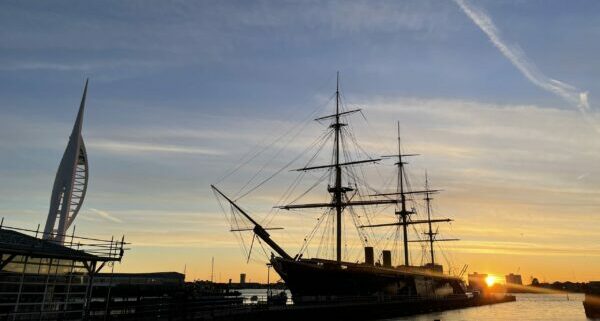
Placing ships within docks enables connections to other historical assets and the creation of maritime heritage centres. This helps attract visitors, in turn enabling the ships to remain financially sustainable and culturally important. HMS Victory is at the heart of Portsmouth’s Historic Dockyard. This places it alongside other major vessels such as HMS M.33, the Mary Rose and HMS Warrior, and within a wider museum complex. The size of this collection and the significance of its contents make this a site of national importance. Similarly, locating HMS Gannet, Cavalier and Ocelot together in the Historic Dockyard Chatham creates a substantial and meaningful monument to Chatham’s long naval history. This could not be achieved by the ships or dockyards in isolation. The Cutty Sark in London is in close proximity to the Old Royal Naval College and the National Maritime Museum, enabling visitors to better understand its place within Britain’s wider maritime heritage. By providing interfaces between the historic ships and their surroundings, docks are key in the creation of cultural hubs.
Finally, docks provide opportunities to create new areas for the public realm. In the Åland Islands, the public can walk on the dock arm around Pommern. A large area of promenade has been created on the quayside, serving as a space for public interactions and events and bringing more life to the community. By delivering wider public benefits as part of a conservation project, the ship has helped to cement its local popularity and significance. Similarly, proposals for the East Graving Dock in Dundee involve emptying and restoring the dock to working order, alongside returning a substantial portion of the dock arm to the public domain. The restoration of an existing swing bridge on the dock arm will allow formation of a continuous path from RRS Discovery to HMS Unicorn and onwards through the city. By providing wider social benefits, this project can create deeper connections with the community and help to ensure its future survival.
In summary, docks provide long-term homes for historic ships, simplifying restoration efforts, supporting ongoing maintenance, and aiding in the preservation of historic fabric. By improving accessibility, they offer visitors new perspectives and opportunities for enhanced interpretation. When effectively designed, docks can strengthen connections between ships and their surrounding communities. Additionally, the presence of historic vessels helps ensure the preservation and continued upkeep of historic docks, preventing their neglect and decay.
Further, combining docks and ships offers the opportunity to create destinations of enhanced cultural and social value. They can forge stronger links to the communities in which they are located, help to ensure a steady flow of visitors, and share common stories and culture. This can serve as a means of regeneration and regrowth. For example, the Hull Maritime Project aims to create a world-class visitor attraction for the future, bringing an additional 300,000 visitors to the city annually and reconnecting the centre of Hull to its historic waterfront. Similarly, the National Museum of the Royal Navy Hartlepool was constructed as part of the economic regeneration of old industrial dockland. It receives 50,000 visitors a year, with ambitious expansion plans launched in 2022 to double this. Through these means, historic ships can act to support the communities that created them.
Acknowledgements
I would like to thank Wynford Davies for his continued support and advice throughout our projects. I would also like to thank Beckett Rankine’s Historic Ships clients for the ongoing collaboration and support, with a particular mention to the Hull City Council Project Delivery Team, the Dundee Heritage Trust, the Unicorn Preservation Society, Hartlepool Borough Council and the National Museum of the Royal Navy. I would like to acknowledge Beckett Rankine’s incredible team, who make these project the successes they are, with a particular mention to Oliver Millar, Mark Thomas, Nathan Smith and Toni Quinn. Finally, I need to thank Tim Beckett and Gordon Rankine for the opportunity to work on these incredibly interesting and exciting projects.
References
Millar O, Thomas M, & Monasta J (2024). Historic ships and docks: a marriage of convenience or the perfect union?. Beckett Rankine. https://beckettrankine.com/wp-content/uploads/2024/09/icmm-congress-24_historic-ships-and-docks-paper.pdf
Historic England (n.d.) The List – Search Results for “Dry Dock”. https://historicengland.org.uk/listing/the-list/results/?search=monumentType%3A%22Dry+Dock%22&searchType=NHLE+Simple [Accessed 10th July 2024].
Stott, P. (2023) Shipbuilding Policy in the UK: The Legacy of a Century of Decline and its Influence on Naval Procurement. The RUSI Journal, 168(5), 54–67. https://doi.org/10.1080/03071847.2023.2250389
National Historic Ships (NHS-UK) (2010) Conserving Historic Vessels. London, UK, National Historic Ships.
Keown, K., Motin, M., Gibson, L. & Ali, L. (2024) On the Brink: Heritage in the Cost of Living Crisis. The Heritage Alliance. https://www.theheritagealliance.org.uk/wp-content/uploads/2024/05/On-The-Brink-Heritage-in-the-Cost-of-Living-Crisis.pdf
BOP Consulting & Raybel Charters (2024) Historic Ships Research Source: Historic Ships Research (heritagefund.org.uk)
National Historic Ships UK (NHS-UK) (n.d.) Albion Dock Company – Bristol’s Largest Dry Dock. https://www.nationalhistoricships.org.uk/page/albion-dock-company-bristols-largest-dry-dock [Accessed 11th September 2024].
Aberg, A. (2005) Saving the Victory. The Mariner’s Mirror 91(2), 358-368. https://doi.org/10.1080/00253359.2005.10656955
BBC (2020) Lord Nelson’s HMS Victory: Visitors able to walk beneath ship. https://www.bbc.co.uk/news/uk-england-hampshire-53728614 [Accessed 11th September 2024].
Unicorn Preservation Society (UPS) (n.d.) Unicorn Preservation Society: 2025 a sustainable future delivered. Unicorn Preservation Society. https://www.hmsunicorn.org.uk/files/docs/downloads/strategicplan.pdf
Hull Maritime (n.d.) The Project. https://maritimehull.co.uk/projects [Accessed 10th July 2024].
Hagmark, H. & Eriksson, B. (2019) En docka för Pommern. http://www.byggab.ax/sites/www.byggab.ax/files/documents/sjohist_31_20191015_pommern.pdf [Accessed 12th July 2024].
Royal Museums Greenwich (2013) Cutty Sark Conservation Project 2006-2012: Recollections from Richard Doughty, Director. https://www.rmg.co.uk/stories/blog/conservation/cutty-sark-conservation-project-2006-2012-recollections-richard-doughty [Accessed 11th July 2024].
Vinci Response (n.d.) HMS Victory: Conserving a Piece of Maritime History. https://www.vinciresponse.co.uk/blog/hms-victory/ [Accessed 15th July 2024].
Watkinson, D. & Tanner, M. (2008) SS Great Britain: Conservation and Access – Synergy and Cost. Studies in Conservation, 53, 109-114. https://doi.org/10.1179/sic.2008.53.
Tresidder, D.J. & Davies, W. (2018) Making the Inaccessible Accessible In: Historic Ships 2018. London. Royal Institute of Naval Architects.
Author Biography
John Monasta is Associate Director at Beckett Rankine. He graduated from Strathclyde University in 2013 with a Master’s Degree in Naval Architecture and Ocean Engineering. Following a career that included working in the offshore energy sector and on large infrastructure projects in London, such as the Crossrail and the Thames Tideway projects, he joined Beckett Rankine in 2018 to develop a new Naval Architecture department in the company.
As part of this, he expanded the Maritime Heritage capability into a core business and specialism within Beckett Rankine, with a specific focus on historic ships. John has worked on the conservation of many historic ships across the UK, including HMS Unicorn and RRS Discovery in Dundee, HMS Belfast in London, HMS Warrior in Portsmouth, and the historic trawlers Arctic Corsair and Ross Tiger on the Humber River, among others. He has authored a number of papers on the subject of conservation of historic ships, and has recently developed a new industry-leading set of guidelines in collaboration with National Historic Ships and the Lloyds Register Fund, focused on the stability of static historic vessels to improve safety in the UK’s maritime heritage sector.
More of our work and papers